
Ripley County Active Warrants
No official Ripley County active criminal warrant search page was located in the research source set. That absence matters. A page that claims a public active-warrant database exists would overstate what the county publishes. The sheriff page provides a 24-hour phone line, jail reports, public-records request access, tax warrants, and related sheriff services, but it does not publish a verified online criminal warrant list for name searches.
Use the fallback chain. For urgent law-enforcement questions, call the Ripley County Sheriff's Office. For bench warrants or failure-to-appear issues, search the underlying case in Indiana MyCase and contact the clerk or court for scheduling and case-status questions. If an arrest has already occurred, the current inmate list or daily arrest report may show custody and offense information. Emergency situations still belong with 911, not a records search.
Important: Do not use third-party warrant sites as proof that a Ripley County warrant is active or cleared.
Ripley County Warrant Types
Different warrant labels point to different agencies and records. An arrest warrant and a bench warrant usually connect to a criminal or court case. A search warrant may be sealed while an investigation is active. A tax warrant is not the same thing as a criminal warrant. Ripley County's sheriff page specifically documents tax warrants for Indiana Department of Revenue and Workforce Development debt, with payment handled through the sheriff's office.
| Warrant type | What it means | Likely access channel |
|---|---|---|
| Arrest warrant | A court order authorizing arrest in a criminal matter. | Sheriff phone, court case, attorney, or surrender instructions. |
| Bench warrant | A warrant issued from court, often tied to failure to appear or court order violation. | MyCase, clerk, Circuit Court, or Superior Court. |
| Search warrant | An order allowing search of a place, device, or property. | May be sealed or unavailable while investigation is active. |
| Tax warrant | A collection tool for state tax or workforce debt. | Sheriff tax-warrants page and sheriff office payment channels. |
| Civil enforcement warrant | A court enforcement tool outside ordinary criminal arrest. | Underlying court case and clerk records. |
Ripley County Warrant Fallbacks
Because no official active-warrant name database was located, the best search is a set of official checks. Each source answers a different question. The sheriff answers active law-enforcement and custody questions. The clerk and courts answer whether a court case, hearing, bond, or failure-to-appear entry exists. MyCase shows many public docket entries. The prosecutor handles filed criminal charges, but it is not a public warrant-clearance counter.
- Call the sheriff's 24-hour number for immediate warrant or custody questions that require law-enforcement confirmation.
- Search MyCase by name or case number to find the court case that may have generated a bench warrant.
- Call the Clerk of the Circuit and Superior Courts for official case status, copy requests, and court balance questions.
- Check the sheriff's current inmate list or daily arrest report if the person may already be in custody.
- Use the sheriff tax-warrants page for Department of Revenue or Workforce Development collection matters.
The Ripley County tax warrants page documents tax-warrant payment paths through the sheriff.
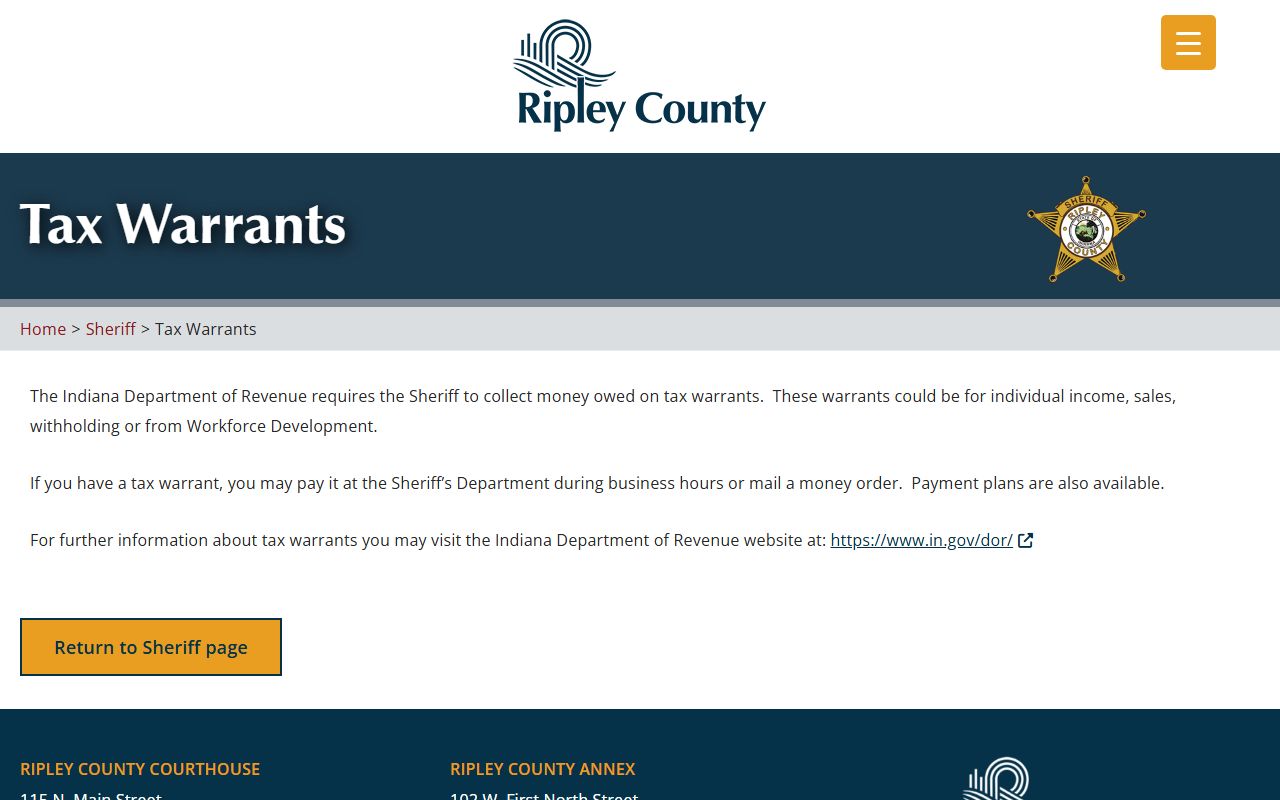
That page supports a clear distinction between tax warrants and active criminal warrants.
Ripley County Warrant Search Fields
No local active-warrant search form was found, so there is no official county warrant form field table to reproduce. The practical field inventory comes from the official fallback sources used to identify an underlying case, arrest, or tax-warrant matter. Those sources are more reliable than an unofficial public-warrant scraper because each one is tied to the office that holds the record.
| Field or fact | Used for | Where it helps | Required |
|---|---|---|---|
| Full legal name | Name match for cases, custody, and sheriff questions. | MyCase, sheriff phone, inmate list. | Usually yes. |
| Date of birth | Separates common names when public systems allow it. | MyCase and law-enforcement confirmation. | Helpful, not always public. |
| Case number | Direct lookup of the underlying court case. | MyCase, clerk, Circuit Court, Superior Court. | Best when known. |
| Charge or statute | Connects the warrant to a filed criminal count. | MyCase, prosecutor, court records. | Optional. |
| Taxpayer or warrant notice details | Identifies tax-warrant debt. | Sheriff tax-warrant payment channel. | Needed for payment handling. |
Ripley County Warrant Record Fields
When a warrant-related item is visible through a court case, inmate report, tax-warrant instruction, or sheriff contact, the public fields may vary. The research supports a practical inventory rather than a promise that all fields appear online. Search warrants and some active criminal warrants may be sealed or withheld. Bench warrant entries may appear only as docket text in the underlying court case.
| Field | What it may show |
|---|---|
| Name | The person tied to the warrant, case, custody entry, or tax-warrant matter. |
| Case number | The court case that generated a bench warrant or failure-to-appear issue. |
| Warrant type | Arrest, bench, failure to appear, probation violation, search, tax, or civil enforcement. |
| Issuing court or agency | The court, sheriff, or state agency tied to the warrant record. |
| Charge or money owed | The offense, statute, court reason, or tax debt that led to the warrant. |
| Bond or payment terms | Public bond detail or tax-warrant payment instructions when available. |
| Resolution entry | Recall, quash, arrest, payment, appearance, dismissal, or other case action. |
The sheriff's bond fees schedule is relevant when a criminal warrant leads to custody and bond processing.
Bond details should still be confirmed through the court, clerk, sheriff, or an attorney because online balances may be incomplete.
Active and Tax Warrants
An active criminal warrant can lead to arrest. A tax warrant is a collection matter. Ripley County's sheriff tax-warrants page states that the Indiana Department of Revenue requires the sheriff to collect money owed on tax warrants, including individual income, sales, withholding, and Workforce Development matters. The page supports payment at the sheriff's department during business hours, money order by mail, and questions about payment plans.
Do not treat a tax warrant as proof of a pending criminal arrest warrant. The word "warrant" is shared, but the legal function is different. A tax warrant may affect collections, liens, or payment duties. A bench or arrest warrant may affect custody, bond, and court appearance. When in doubt, ask which office issued the warrant and which case or account number is attached.
Resolve a Ripley County Warrant
Confirm the warrant through an official source before taking action. If represented, call counsel first. If the matter is a bench warrant, ask the clerk or court about the underlying case, hearing history, and whether an appearance or bond is required. If the matter is an arrest warrant, follow law-enforcement or attorney instructions. If the matter is a tax warrant, ask the sheriff's office about payment by in-person payment, money order, or payment plan.
- Confirm whether the warrant is criminal, bench, tax, civil, or search-related.
- Identify the issuing court, agency, case number, or tax-warrant account detail.
- Ask whether bond, payment, or a court appearance is required.
- Keep any receipt, order, bond paperwork, or recall entry showing the warrant was addressed.
- Recheck the underlying court case after resolution, because online updates may lag.
Sheriff Sale Records
Sheriff sales are separate from warrant searches, but they are part of the sheriff's court-adjacent records ecosystem. Ripley County sheriff sale procedures changed as of November 2025, and the county says sales are now online through SRI Services. The county sheriff-sale procedure page documents the official local source for that separate sheriff function.
The Ripley County sheriff sale procedures page explains the county's online sheriff-sale process.
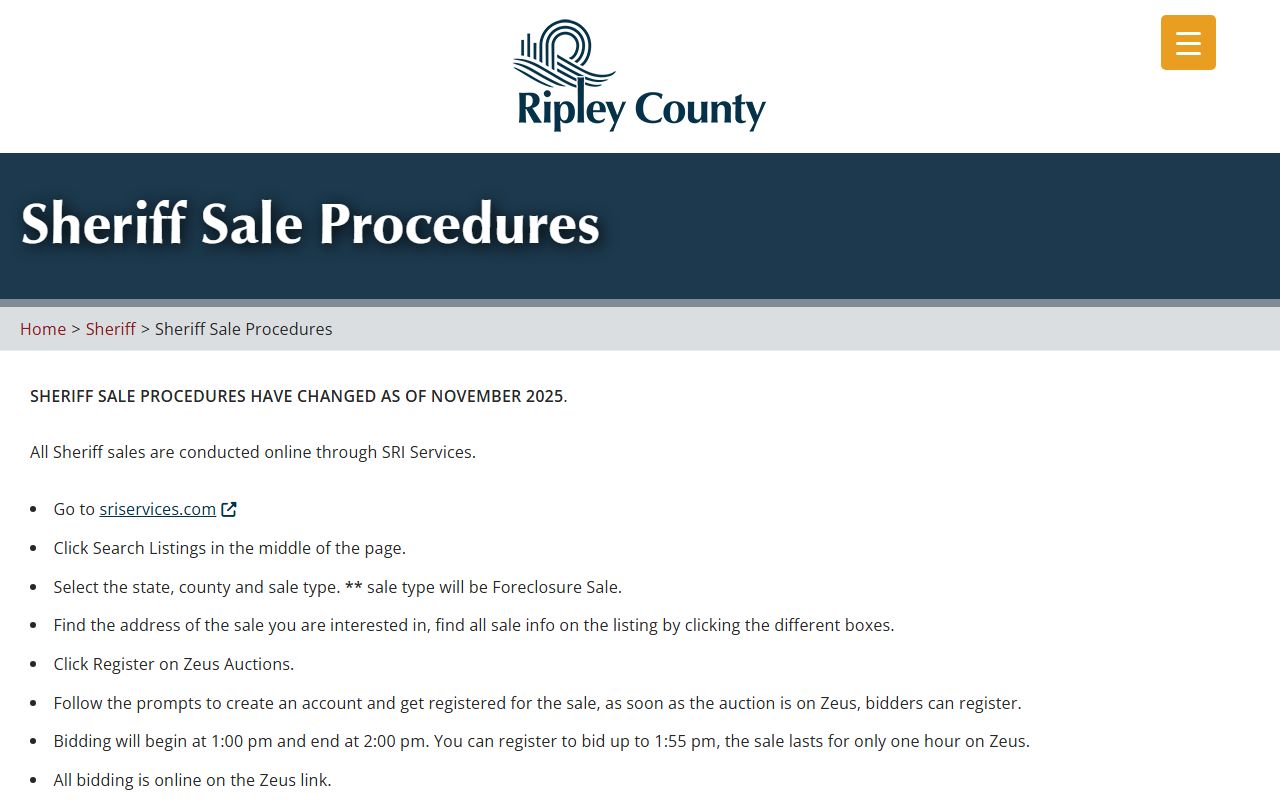
Sheriff sale records should not be confused with arrest, bench, or tax warrant status.
Restricted Ripley County Warrants
Some warrant records are not public in real time. Search warrants may be sealed while an investigation is active. Juvenile matters can be confidential. Protected-order information has special online limits. Arrest-warrant confirmation may be limited to law enforcement for safety or operational reasons. MyCase may show an underlying public criminal case but not every warrant document or law-enforcement entry.
Federal warrants are also outside Ripley County court records. Federal custody or federal criminal cases use federal channels such as PACER, the U.S. District Court for the Southern District of Indiana, the U.S. Marshals process, or the Bureau of Prisons after sentencing. Local sheriff and clerk staff cannot clear a federal warrant through the county court file.
Note: A public court case can show a failure-to-appear history without proving that a warrant remains active today.